
After the Status Quo Failed

At the DNC’s winter meeting, Kamala Harris argued that defeating Trump is not enough—and warned Democrats against restoring the system that produced him.
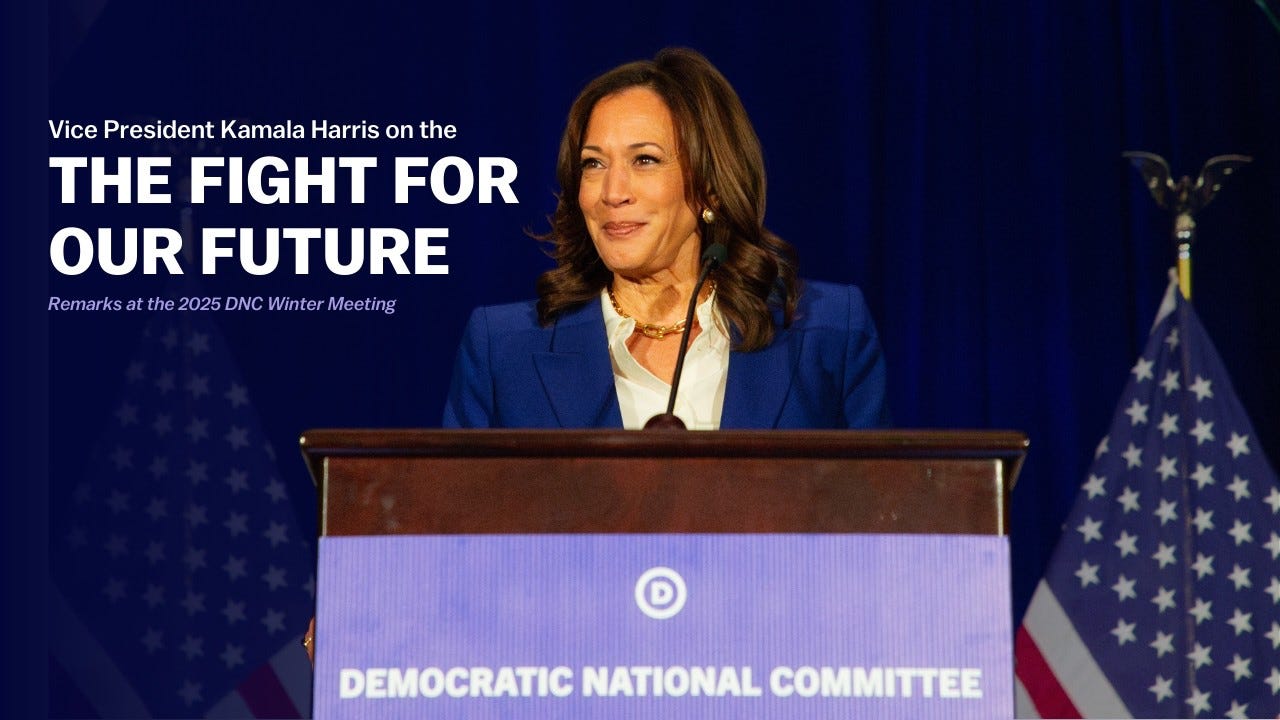
The ballroom choreography was familiar—applause cues, standing ovations politely deferred, the ritual humility of party leadership—but the substance of Vice President Kamala Harris’s remarks at the 2025 Democratic National Committee Winter Meeting cut against nostalgia. This was not a victory lap, nor an attempt to paper over the bruises of 2024. It was, instead, a diagnosis of systemic failure—and a warning that Democrats cannot simply run backward into a broken past.
Harris arrived not as a candidate, but as a witness: to a campaign fought at full throttle, to a country under economic and civic strain, and to a political system that large numbers of Americans no longer believe works for them. The speech she delivered in Los Angeles was framed as “the fight for the future,” but its core argument was more unsettling. The future, she suggested, will not arrive on its own. It must be rebuilt—deliberately, structurally, and with a clear break from the status quo that produced Trumpism in the first place.
The Labor That Doesn’t Trend
Harris began by situating herself not above the room, but inside it. She thanked party leaders not simply for campaign support, but for the kind of political labor that rarely earns applause—the weekends that vanish, the work that does not trend on social media, the efforts that advance the country without producing viral moments.
That framing mattered. Throughout the speech, Harris returned to the idea that visible leadership is downstream from invisible work. When people thank her in public, she said, they are really thanking the organizers, volunteers, and officials who stand up for democracy, the rule of law, and constitutional principles when it is inconvenient or unrewarded.
It was an argument about legitimacy. Democratic leadership, Harris insisted, derives not from spectacle or personality, but from collective effort in service of shared values. In a moment when political authority is increasingly personalized—and weaponized—that distinction was deliberate.
Proof of Life After 2024
Harris rejected the premise that Democrats are retreating. She pointed instead to recent elections as evidence of persistence and reach: Abigail Spanberger becoming Virginia’s first woman governor; Mikie Sherrill winning New Jersey’s governor’s mansion; Zohran Mamdani inspiring a broad coalition in New York City; California voters passing Proposition 50.
She lingered on the Deep South, where legislative maps had been drawn, she said, to silence Black voters. In Mississippi, Democrats broke the Republican supermajority in the state senate. In Georgia, Alicia Johnson and Peter Hubbard flipped state senate seats. From Richmond to Trenton, Jackson to Atlanta, Sacramento to New York, Harris argued, voters sent a consistent message: they want leaders who fight—for affordability, healthcare, and the right to participate in their democracy.
The implication was strategic as much as celebratory. Democrats, she said, must compete everywhere: every state, every district, every level of government. This was not a call for defensive consolidation, but for expansion.
Trump as Symptom, Not Sole Cause
Harris did not minimize the damage Donald Trump has done. She recited the reality plainly: prices are up, inflation is up, unemployment is up, and healthcare costs for millions of Americans are about to double. She contrasted those conditions with Trump’s recent assessment of the economy—an “A-plus, plus, plus, plus, plus”—and dismissed it outright. “There is nothing A-plus about any of this,” she said.
But Harris refused the easier political move: treating Trump as the singular explanation for the country’s unraveling.
“Real talk,” she told the room. Trump is not the only source of what Americans are experiencing. The rise of Trump and the MAGA movement, she argued, is a symptom—the visible eruption of a system that has been failing people for years.
She named the architecture of that failure without euphemism: decades of outsourcing and offshoring, financial deregulation, widening inequality, a broken campaign finance system, and endless partisan gridlock. These were not abstract policy disputes, but cumulative choices that hollowed out trust and concentrated power, leaving large portions of the public feeling locked out of decisions shaping their lives.
In that context, Trump’s self-presentation as a change agent was not surprising. When institutions appear unresponsive, Harris suggested, people become willing to break things to force change. Cynicism hardens into anger. Frustration curdles into permission.
The danger, Harris warned, is not only Trump himself, but what happens if Democrats misunderstand the lesson. If Trumpism is treated as an anomaly to be endured and erased, the conditions that produced it remain intact. A simple return to the pre-Trump order would amount to restoring a flawed status quo that failed too many people for too long.
“We cannot afford to be nostalgic,” Harris said.
Her rejection of nostalgia was not rhetorical. It was strategic. Defeating Trump without confronting the structural failures beneath him would all but guarantee repetition—another figure, another eruption, another crisis of legitimacy. The task ahead, she made clear, is not restoration, but reinvention.
Civic Renewal as a Governing Requirement
The heart of Harris’s speech was not a policy list, but a framework she returned to repeatedly: civic renewal. The work ahead, she argued, is not merely political. It is about restoring public agency in a system where power has become dangerously concentrated.
She returned to a mantra she has used throughout her career—the power is with the people—and acknowledged that many Americans no longer believe it. Hard work alone no longer guarantees stability. Forces shaping daily life feel distant and uncontrollable. Political and economic power is increasingly concentrated in the hands of the very few.
That concentration, Harris argued, is the mark of a corrupted system, corrosive to democracy itself. Confronting it means reforming institutions so that everyday citizens—not corporations, not elites, not career politicians—are once again in charge.
Civic renewal, as Harris described it, rests on shared values: that all work contributes to the public good and deserves dignity; that economic security must be paired with health, safety, and community; that technology should enhance human ingenuity rather than replace it; that government must be responsive, transparent, and not for sale; that advancing justice and equality strengthens society as a whole.
To rebuild civic solidarity, she argued, the country must invest in national service, public education, public spaces, and ambitious collective projects—efforts that remind Americans of what they can achieve together.
The Stakes After 2026
Harris closed with urgency, but not despair. The stakes, she said, have never been higher—not because of any single election cycle, but because the underlying question of who governs remains unresolved.
The future she outlined was not one commanded by corporations, career politicians, elites, or the wealthy. It was not a future ruled by kings or oligarchs. It was one governed by everyday citizens, each working to fulfill their potential not only for themselves, but for the country as a whole.
That vision cannot be postponed until after the next election or delegated to some later moment. It demands clarity about what Democrats stand for and the willingness to fight for it—now and in the years ahead.
If Trump and MAGA politics are the symptoms of a corrupted system, then the test of the post-2026 era will be whether Democrats confront that system or merely manage its consequences. Civic renewal, as Harris framed it, is not aspirational branding. It is a governing requirement.
The choice ahead is not between chaos and calm, or disruption and restoration. It is between repeating the conditions that produced this moment and doing the harder work of structural change—rebuilding trust, dispersing power, and restoring agency to the people from whom government derives its legitimacy.
“We fight for the future,” Harris said. “We fight for the people.”
What happens after 2026 will determine whether those words describe a governing philosophy—or remain a warning unheeded.
Never too late unless you just give up!
Too late, Kamala. You didn’t know this a year ago?