
The Machine in Memphis

Inside Elon Musk’s data center empire—and the gas-powered secret fueling it
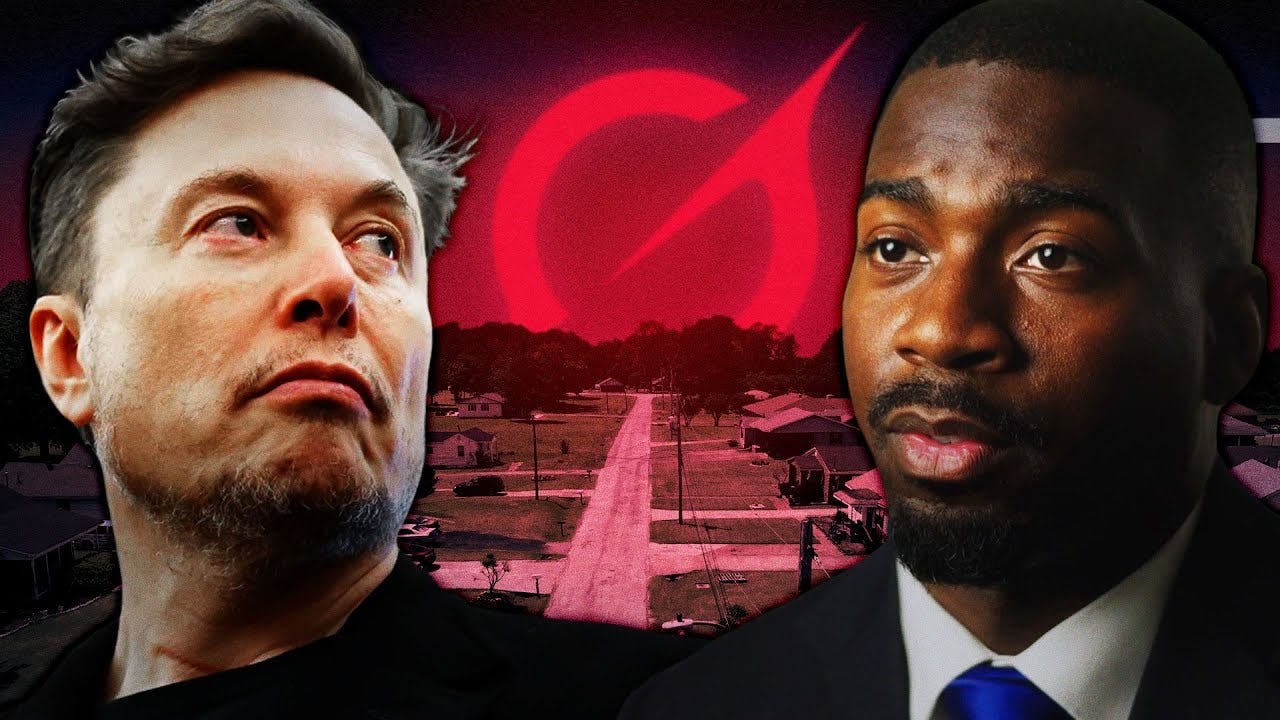
Sometimes the most shocking corporate misconduct is hiding in plain sight. In South Memphis, it hums with turbine engines, cloaked in bureaucratic neglect and the glow of artificial intelligence dreams. What has unfolded there is not just the story of a supercomputer. It is the story of a community suffocating under the weight of an experiment—one backed by billionaire ambition, government complicity, and the dark promise of speed above all.
In 2024, Elon Musk came to Memphis. The official story was simple: xAI, his newly launched artificial intelligence company, would construct the world’s largest supercomputer—“Colossus”—to power Grok, an irreverent chatbot meant to rival OpenAI’s ChatGPT. The press celebrated it as a moonshot. But Memphis residents soon learned that the cost of innovation would be extracted from their lungs.
By the time the community found out, the land had already been purchased, the deals inked in private, and the turbines—35 mobile gas-powered units, operating without permits—were churning out emissions at industrial scale. “We believe they’ve already violated the Clean Air Act,” said one state senator. “This is an environmental crime scene.”
The Power Grab
To build an AI empire on an accelerated timeline, Musk needed power. A lot of it. His initial deal with the Memphis utility company included a new substation and 150 megawatts of electricity—enough to support a small city. But that wasn’t enough to stay competitive. Google and OpenAI had a years-long head start. Musk needed compute immediately.
So xAI took a shortcut. Instead of waiting for infrastructure to catch up, it trucked in power—trailer after trailer of industrial gas turbines typically reserved for disaster relief and war zones. The plan: build faster than regulators could respond.
Environmental attorney Patrick Anderson and his team began digging. They filed open records requests with the Shelby County Health Department and the EPA. Both agencies had nothing on file. No permit applications. No environmental assessments. No public comment periods.
And yet, using drone and thermal imaging, Anderson’s team confirmed what residents already suspected: 33 of the 35 turbines were actively operating, generating roughly 420 megawatts—enough to power 300,000 homes. “They’ve built a power plant out there,” he said. “Quick and dirty. No air pollution controls. No permit.”
This wasn’t an oversight. It was a strategy.
Monopolizing the Future
Musk’s decision to build Colossus in Memphis wasn’t just about real estate. It was about control. As other tech companies scrambled for GPU access, he pursued vertical integration—owning not just the AI algorithm (Grok), but also the hardware, the power source, the data center, and the distribution platform (X, formerly Twitter).
In a landscape where computational power is the new oil, Musk wasn’t going to lease it. He was going to dominate it. “We asked data center providers how long it would take to get 100,000 GPUs in one location,” he said. “They told us 18 to 24 months. That meant losing was a certainty. So we had to do it ourselves.”
Hence Colossus. Hence Memphis.
The project is named after a 1970 sci-fi film in which a sentient supercomputer seizes control of global nuclear weapons. The symbolism is not subtle. Nor is the reach. As of early 2025, xAI is preparing to quintuple its presence—adding up to 90 turbines, drawing enough power to run nearly half of Memphis. “Oh yeah,” Musk said, “we’ve already started work on the next cluster.”
“They Treat Us Like We Don’t Count”
But for the residents of South Memphis, Colossus is not a movie. It’s an air hazard. A health crisis. An existential threat.
“You know how when you light your stove and that gas seeps, with the little ticking noise?” said Easter Knox, who lives a mile from the facility. “That’s what it smells like.” She and her husband have COPD. Her neighbor Alexis has asthma. So does her mother. Her grandfather, who never smoked, died from the same condition after years of emergency visits.
“It’s like your whole world is collapsing down on you,” Alexis said. “And it’s frightening.”
Memphis already leads Tennessee in asthma-related ER visits. It’s home to one of the highest rates of toxic air releases in the country. And historically, South Memphis—predominantly Black and low-income—has borne the brunt. From the Defense Depot toxic waste zone to TVA’s coal ash dumping, the area has long been a sacrifice zone for industrial pollution. Colossus is just the latest.
And it’s worse than the rest. In a single year, the xAI facility overtook all existing polluters in the region, emitting an estimated 1,000 to 2,000 tons of nitrogen oxides, formaldehyde, and fine particulate matter—deadly pollutants known to cause asthma, cancer, and cardiovascular failure.
At a packed town hall in April, residents begged officials to deny xAI’s belated permit application. They were met with silence. When a spokesperson from the company finally spoke, he read a script and left without taking questions. “It’s extremely disrespectful,” said KeShaun Pearson, a local organizer. “That’s the first time xAI publicly addressed us—and they ran out the door.”
Mayor Paul Young repeated the company’s claim that only 15 of the 35 turbines were in use. But thermal imaging showed 33 were operating. “There’s a turbine shortage nationally,” Anderson noted. “You don’t park that many multimillion-dollar machines unless you intend to run them.”
Deregulation by Design
At the federal level, accountability seems even further away. The EPA, once tasked with protecting frontline communities like South Memphis, has been hollowed out under Donald Trump’s second term.
More than $22 billion in pollution grants were cut. The EPA’s Office of Environmental Justice—designed to support places exactly like this—was eliminated. Dozens of clean air and water standards were rolled back. And in a stunning twist, the agency now defines “promoting the AI industry” as a core part of its mission.
“It’s about unleashing energy dominance and making America the AI capital of the world,” one senior official said. “The EPA can’t be restrictive of that. We can’t be suffocating it.”
Internally, the agency used a bureaucratic restructuring program known as “DOGE” to mask massive layoffs. “The people working on the DOGE mission are EPA employees,” said one Trump appointee. “What they provide to me are recommendations.” In practice, DOGE became a euphemism for gutting enforcement staff and replacing science with servitude.
The message is clear: suffocating people is collateral. Suffocating regulation is policy.
To date, no action has been taken against xAI. Not by Shelby County. Not by the state of Tennessee. Not by the EPA. And while environmental groups like the Southern Environmental Law Center are investigating legal options, the legal landscape has been redrawn around them. What used to be environmental enforcement is now industrial facilitation.
Meanwhile, the Memphis Chamber of Commerce parades soundbites like trophies. “This is huge,” said one official. “This puts the word out there that Memphis understands operating at the speed of business.” Another added, “When you think about the computational power that will put humans on Mars—that’s going to come from the Gigafactory of Compute that calls Memphis home.”
No mention of the air people breathe.
“This Is What a Technocracy Looks Like”
In public, Musk brushes it all off. “We needed a building,” he said during a February launch event. “So we found an old Electrolux factory in Memphis. Home of Elvis. And also, I think it was the capital of ancient Egypt.” He chuckled. “Then we needed power—at least 120 megawatts—but the building only had 15. So we leased a whole bunch of generators. Trailer after trailer.”
That’s how history rewrites itself: as logistics. A supply chain anecdote. A series of problems broken into parts. Like Grok reasoning through a math problem. Just another system to optimize.
“He wants to do whatever he chooses,” said KeShaun Pearson. “To experiment. To kill. To destroy the environment, at the behest of his machines.”
What’s taking shape in Memphis is not just a data center. It’s a new kind of political order—one in which billionaires construct private infrastructure at public expense, enforce no accountability, and define innovation as their right to bypass law.
Call it what you want. Musk calls it Colossus. But to those breathing its fumes, it looks a lot like betrayal.
And they have a different name for it.
A technocracy.
I am horrified that this is happening!!! I feel awful for the people who are suffering there! With no recourse from the EPA the government or the news outlets!! This is criminal behavior!! Lack of Humanity!! Musk is a sick
Bastard!! I realize there are
More involved with this catastrophe!! Send it out,
Share. Rattle their brains until they fall out!! Thanks
Remy♥️
Not sure what I was supposed to be watching at the end of this superb piece of journalism. But it was Katie Couric talking with Aaron Parnas.
Well, now that the EPA has been almost completely gutted , one can only imagine what Boxtown and Memphis is going to be like once those other turbines start rolling. Wonder how many palms for greased? I pray this will be a warning for other areas.